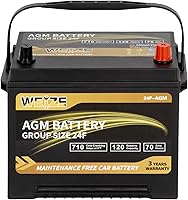
How Much Does an H6 AGM Battery Weigh?
An H6 (Group 48) AGM battery typically weighs about 45 to 50 pounds. Two common examples sit at 46 pounds and 45 pounds, so plan the lift and the swap around that range.
On this page (8 sections)
- What does an H6 AGM battery actually weigh?
- Why is an H6 AGM battery heavier than a flooded battery?
- Does a heavier H6 AGM battery mean more capacity?
- How does the H6 size compare with other group sizes by weight?
- Why does battery weight matter when you plan a replacement?
- How do you safely lift and install a heavier AGM battery?
- How do you check the new battery after the swap?
- Which H6 AGM battery fits your weight and power needs?
An H6 AGM battery weighs about 45 to 50 pounds. Two Group 48 AGM batteries in this size class come in at 46 pounds and 45 pounds, so that is the range to plan around.
If you are checking how much does an H6 AGM battery weigh before a swap, expect to handle a dense, sealed block rather than a light plastic case.
That number matters more than it looks on paper. You will lift it out of a parts store bag, carry it to the car, and lower it into a tight engine bay.
A 46 pound battery is heavy enough that grip and footing deserve a moment of thought.
What does an H6 AGM battery actually weigh?
The typical figure is 45 to 50 pounds for a Group 48 AGM. The Weize Platinum AGM Group 48 weighs 46 pounds.
The Autocessking AGM Group 48 weighs 45 pounds.
Both fit the H6 / Group 48 footprint, so the weight band is narrow.
The range is real, not rounding. Battery makers vary the plate count, the mat thickness and the case design, and each change moves the scale a little.
A 1 to 2 pound spread between two H6 AGM batteries is normal.
Plan for the top of the range, not the bottom. If you expect 45 pounds and get 46, the lift is the same but your grip is already set for the load.
Weigh your old battery on a bathroom scale before you order if you want a baseline, but remember a used flooded battery has lost some acid over the years.
Why is an H6 AGM battery heavier than a flooded battery?
AGM holds its acid in glass fiber mats, and that mat plus the tighter plate stack adds mass. A flooded battery leaves acid as free liquid sloshing around the plates.
AGM suspends the acid in a dense separator material that soaks it up and holds it in place.
That design is the reason AGM batteries resist leaks and handle vibration. It is also the reason they weigh more per unit of capacity.
The trade is straightforward: you carry a few extra pounds in exchange for a sealed, spill-proof case.
The weight difference is not huge, but you feel it when you lift. A Group 48 flooded battery and a Group 48 AGM of similar capacity are close in size and closer in weight than people expect.
What else adds to the weight of an AGM case?
The sealed case itself is part of it. An AGM battery has to hold its internal pressure and keep the mat compressed against the plates, so the case is built sturdier than a vented flooded shell.
Autocessking says its Group 48 AGM suspends the acid within glass fiber mats to prevent leaks and corrosion. That sealed construction is what makes the unit safe to handle and ship without a vent cap ritual.
It also means fewer ounces leave over time, so the weight you buy is close to the weight you carry out years later.
Does a heavier H6 AGM battery mean more capacity?
Broadly, extra weight tracks more lead and more acid, which usually means more amp-hours and cold cranking amps. The Weize Platinum AGM Group 48 pairs its 46 pounds with 70 Ah and 760 CCA.
That is a lot of stored energy for a compact case.
Weight is a rough proxy, not a rule. Two batteries can weigh the same and differ in CCA because of plate design.
Use the printed ratings, not the scale, to compare power.
Still, when you see a 45 pound H6 AGM and a 38 pound one in the same group size, the lighter unit is usually the lower-capacity build. Check the labels before you assume.
The Weize Platinum AGM Group 48 also carries a 120 reserve capacity rating alongside the 70 Ah and 760 CCA, and reserve capacity is the number that tells you how long accessories can run if the alternator quits. That figure tracks the amount of active material inside, which is exactly what pushes the scale up.
How does the H6 size compare with other group sizes by weight?
H6 sits in the middle of the common car battery sizes. A Group 35 battery is smaller and lighter, while a Group 65 battery is longer and heavier.
The H6 / Group 48 case measures roughly 10.9 by 6.9 by 7.5 inches.
Weight scales with case volume and plate count. A Group 35 is a compact fit for many smaller cars.
A Group 65 fills the wide trays in full-size trucks and SUVs. H6 lands between them.
If your tray takes an H6, do not assume a Group 35 will fit just because it weighs less. Length and hold-down points matter more than the scale.
Compare Group 35 battery options only if your vehicle lists that size. The Autocessking case measures 11 by 6.9 by 7.5 inches, so even within the H6 label there is slight variation.
A tape measure in hand beats guessing from a photo.
Why does battery weight matter when you plan a replacement?
Weight affects the lift, the hold-down hardware and the shipping cost. A 45 to 50 pound battery is heavy enough to strain a wrist if you carry it at arm's length.
Lower it close to your body and set it down flat.
The bracket matters too. A heavier AGM battery puts more load on the tray lip and hold-down bar.
Check that the clamp is tight and the tray is not cracked before you drop the new unit in. Both Group 48 picks here are built with vibration resistance in mind, which matters because a heavy battery that rattles will wear its own plates and the tray over time.
Shipping is the third factor. Batteries in this class cost more to ship and often carry handling rules.
Read the return policy before ordering so you are not stuck paying to send a 46 pound box back. Weize backs its unit with a 3-year warranty and Autocessking backs its unit with 3 years as well, so keep the box and the receipt in case a return or claim comes up.
How do you safely lift and install a heavier AGM battery?
Use two hands, keep the battery close to your chest, and lower it straight down onto the tray. AGM cases have molded handles, but they are small.
Grip the case body, not just the handle, when you can.
Clear the engine bay first. Remove the old battery, then check the tray for corrosion and debris.
A clean, flat tray helps the new battery seat without rocking.
Set the battery in the correct orientation. The Weize Platinum AGM Group 48 has the negative terminal on the left and positive on the right.
Match the old battery's layout so the cables reach without strain. Autocessking's fitting guide makes the same point: measure the old battery and compare the dimensions, and confirm the positive and negative poles line up before you buy.
What should you check on the old battery before the swap?
Look at the hold-down bar and the bolts first. If they are rusted or rounded, deal with that before the new battery goes in.
Then check the cable ends for corrosion; a 46 pound battery sitting on dirty clamps will not start the car any better than a cheap one. Finally, note the date on the old battery and keep it.
It tells you how long the last unit lasted and whether the new AGM is due for the same service life.
Tighten the hold-down before you connect the terminals. A heavy battery that shifts under braking can loosen a cable or crack the case.
Connect positive first, then negative, and snug the clamps. Then test before you close the hood.
How do you check the new battery after the swap?
Test the battery and the charging system before you call the job done. A load tester tells you whether the battery holds voltage under load.
It also shows whether the alternator is charging properly.
The Schumacher BT-100 runs a load test, a charging system check and a starter draw test on 6V and 12V batteries. That covers the three things you want to know after a swap.
It handles batteries up to 1,000 cranking amps, well above the 760 CCA of either H6 AGM here, so the tester has headroom.
Connect the clamps, follow the steps for the test you want, and read the analog meter. A healthy 12V battery should hold steady under load.
A weak reading points to a bad battery or a charging problem.
Test again after a week of driving. A new battery that drops fast under load may be defective or undersized for the car's electrical load.
That is useful to know before the warranty window closes. If the meter shows the charging system is weak, fix that before the new battery takes the blame.
Which H6 AGM battery fits your weight and power needs?
Match the battery to your car's required group size first, then pick the capacity you need. The Weize Platinum AGM Group 48 is the higher-capacity pick at 70 Ah and 760 CCA in a 46 pound case.
The Autocessking AGM Group 48 is a 45 pound option with the same 70 Ah and 760 CCA ratings.
Both are starting batteries. Neither is meant for deep-cycle use such as solar or marine power.
Weize says its AGM is not suitable for solar projects or marine use, and Autocessking makes the same exclusion for solar, RVs and marine. If your car came with a flooded battery and you are thinking about switching, read can I put an AGM battery in my car before you buy.
Autocessking's fitting guide warns against the reverse move too, so do not drop a flooded battery into a car that came with AGM.
Measure your old battery and compare the dimensions and terminal positions. A 45 or 46 pound unit that does not fit the tray is no bargain.
For more Group 48 options, see the roundup of the group 48 battery picks.
Frequently asked questions
Can one person lift and install an H6 AGM battery?
Yes, but 45 to 50 pounds held at arm's length in an engine bay is awkward. Use two hands, keep the battery close to your body, and lower it straight down onto the tray rather than tipping it.
Does H6 AGM battery weight affect shipping or returns?
It can. A 45 to 50 pound battery costs more to ship and may carry special handling rules.
Check the return policy before ordering, and keep the original box in case you need to send it back.
Do I need to change anything else when swapping to a heavier AGM battery?
Check that the hold-down bracket, tray lip and terminal clamps are in good shape, since the new battery is heavy and will move if it is not secured. Measure the old battery first so the replacement drops into the same space.