EFB vs AGM Car Battery: What Is the Difference?
The difference between EFB and AGM car battery types is cycle life and price. EFB is the cheaper upgrade for basic stop-start cars, while AGM handles heavier electrical loads and lasts longer in cars with regenerative braking or many accessories.
On this page (7 sections)
The difference between EFB and AGM car battery types is cycle life and price. EFB is the cheaper upgrade for basic stop-start cars, while AGM handles heavier electrical loads and lasts longer in cars with regenerative braking or many accessories.
Both are sealed lead-acid batteries built for engines that shut off in traffic. They look similar in the box, so the real choice is about what your car asks of the battery.
What is an EFB battery?
An EFB battery is an enhanced flooded battery, a step up from the plain flooded battery in older cars. Its plates are wrapped to hold the electrolyte in place, so it tolerates more charge and discharge cycles than a standard wet battery.
That makes it the entry-level pick for stop-start. A car that switches the engine off at a red light and back on again asks a lot of its battery, and a plain flooded unit wears out fast under that routine.
EFB is built to take the repeated cycling without costing as much as AGM.
EFB still uses liquid electrolyte, so it must not be tipped or installed upside down. It suits cars with light stop-start systems, modest accessory loads and no heavy electrical demands.
Many automakers fit EFB from the factory as the standard stop-start battery.
If your car came with EFB, a like-for-like EFB replacement is the safe and affordable path. Moving up to AGM is possible in some cars, but only when the charging system supports it.
EFB is the cheaper of the two, so it is also the easier cost to swallow when the battery finally wears out after years of city driving.
What is an AGM battery?
An AGM battery is an absorbed glass mat battery. The electrolyte is soaked into fiberglass mats between the plates instead of sitting as free liquid, which makes the battery sealed and spill-proof.
That construction gives AGM a higher cycle life than EFB. It also handles deeper discharges better, so it suits cars with heavier electrical loads: heated seats, big infotainment screens, driver aids and regenerative braking.
Our explainer on what does AGM stand for in an AGM battery covers the design in more depth.
AGM is more expensive than EFB and needs a charging system set up for it. When it fits, it lasts longer and holds its charge better during long idle spells.
Many premium and performance cars fit AGM as standard.
The sealed build also pays off in safety and placement. With no free acid to spill, AGM units resist leaks and corrosion on surrounding parts, and some can be mounted in more than one position as long as they are not upside down.
That matters in tight engine bays and on vehicles that see vibration.
If you want the full picture of how AGM sits against the older wet battery, see our comparison of AGM vs lead acid car battery.
What is the difference between EFB and AGM car batteries?
The difference between EFB and AGM car battery designs comes down to how the acid is held. EFB keeps liquid electrolyte and AGM locks it into glass mats.
That single change drives the price gap, the cycle-life gap and the fit rules.
Here is the comparison in plain terms:
| Point | EFB | AGM |
|---|---|---|
| Acid storage | Liquid electrolyte in wrapped plates | Electrolyte absorbed in glass fiber mats |
| Cycle life | Good, above flooded | Longer, above EFB |
| Cost | Lower | Higher |
| Best use | Basic stop-start cars | Cars with heavy loads or regenerative braking |
| Spill risk | Low but not sealed | Sealed and spill-proof |
The practical takeaway: EFB is the budget-friendly stop-start battery, and AGM is the longer-lasting one for cars that demand more. Neither is "better" in a vacuum; the right one depends on what your car was built to use.
The gap shows up in real numbers on the AGM side. A Group 35 AGM unit like the Weize Platinum runs 55Ah with 650 cold cranking amps and a 100-minute reserve capacity, and its maker rates it at up to twice the cycle life of a conventional battery.
The same figures repeat on the Goodyear Platinum AGM Group 35, which pairs 55Ah and 650 CCA with the same 100-minute reserve. Those are the ratings to match against your old battery, whatever the label says.
Which battery does your car actually need?
Check what type is already in the car before you buy. The battery you take out is the safest guide, and the owner's manual or a dealer parts desk will confirm it.
If the car came with AGM, fit AGM. Swapping down to EFB or flooded can leave the battery undercharged and short-lived, because the charging system expects AGM's behavior.
Cars built for EFB can sometimes take AGM as an upgrade, but only when the charging setup allows it. Our guide to can I put an AGM battery in my car walks through the cases where that works.
Match the group size and cold cranking amps too. A battery with the wrong physical size won't fit the tray or connect to the terminals, and too little CCA can struggle in cold starts.
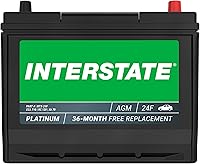
Both battery types below are Group 35 AGM units with 650 CCA and a 100-minute reserve capacity.
Two Group 35 AGM options
Both carry the same size and rating, so the choice between them comes down to brand preference and fit in your tray. Measure your old battery and compare the dimensions before ordering either one.
The Weize unit lists 9.06 by 6.89 by 8.82 inches with the positive terminal on the right. The Goodyear unit lists 9.00 by 7.00 by 8.87 inches with positive on the right and negative on the left.
Those small differences are why you measure first.
Does stop-start really shorten battery life?
Yes, stop-start cycling wears a battery faster than a car that never shuts off. Every engine restart draws a burst of current and drains the battery a little, and the alternator has to top it back up.
That is why automakers moved to EFB and AGM in the first place. A flooded battery in a stop-start car often fails within a few years.
EFB and AGM are built to cycle more times before they wear out, with AGM handling the most cycles.
Driving habits matter too. Lots of short trips with the engine stopping and starting, plus accessories running, put more strain on the battery.
Cars used mainly for long highway runs give the battery more time to recharge. Climate plays a part as well: AGM's glass mat materials are built to hold performance in both hot and cold weather, so the same battery copes with a summer heat wave and a freezing morning.
If your stop-start car is a few years old and cranks slowly, the battery is the first thing to check. Test it before it leaves you stranded.
Can you test an EFB or AGM battery at home?
Yes. A digital battery tester reads the state of health and charge on both EFB and AGM batteries.
It saves guessing and tells you whether the battery is weak or simply needs a charge.
The ANCEL BA101 covers flooded, AGM, GEL and EFB batteries. It reads state of health, state of charge, voltage, current and CCA, and runs cranking and charging tests.
That range matters here, since the tester has to be set to the right battery type for a useful reading. Its load range runs from 100 to 2000 CCA, which covers a Group 35 battery's 650 CCA without trouble.
It works on 12V batteries in cars, trucks, boats and more, and it is not for lithium batteries or 6V and 24V units. Enter the battery type, CCA rating and temperature as shown on your battery label so the reading matches reality.
The clamps are copper and the unit runs off the battery being tested, so there is nothing to charge first. For a 6V battery you would need the BA101 Plus, and for 24V the BA101 PRO.
Reading the result
For a stop-start car, a test every few months shows whether the EFB or AGM unit is holding up. A slow crank plus a low state of health points to a replacement.
A low state of charge with a healthy reading usually means the car is not getting enough charging time and needs a proper charger run, not a new battery.
How do you choose between EFB and AGM?
Stick with the type your car was built for, then weigh cost against cycle life. For most basic stop-start cars, EFB is the sensible, affordable replacement.
For cars with heavy loads or regenerative braking, AGM is the one that lasts.
If you are upgrading, AGM gives more cycles and better deep-discharge behavior, and it holds charge longer when the car sits. EFB costs less and is easier to justify when the car's demands are modest.
Our guide to AGM truck battery picks shows the AGM side for heavier vehicles.
Either way, match the group size, CCA and terminal position first. Get those right and the difference between EFB and AGM car battery choices becomes a simple question of what your car asks for.
Buy EFB for a light stop-start system and AGM when the electrical load or the driving cycle is heavier. Remember that AGM starter batteries are not meant for deep-cycle use in solar or marine projects, so keep the two jobs separate.
Frequently asked questions
Is an EFB battery better than a standard flooded battery?
Yes for stop-start cars. An EFB holds up to more repeated charging cycles than a plain flooded battery, so it copes with an engine that shuts off and restarts in traffic.
It costs less than AGM but still is not the right fit for every vehicle.
Can I mix an EFB battery into a car that came with AGM?
No. If the car was built with an AGM battery, fit AGM again.
AGM batteries charge at a different rate, and the car's charging system is set up for that, so a cheaper EFB can undercharge and wear out early.
Do I need to tell the car when I fit a new AGM battery?
Often yes. Many stop-start cars use battery management that tracks the age of the battery.
A registration step tells the car a fresh battery is fitted so it charges correctly.
A workshop or a scan tool can do it.
How long does an EFB battery last compared with AGM?
AGM usually lasts longer. Its glass mat design handles deep discharges and repeated cycling better than EFB, so it keeps working through more stop-start events.
EFB is still a step up from flooded and is cheaper to replace.