AGM vs Lead Acid Car Battery: Which One Do You Need? (October 2026)
Choose AGM if your vehicle requires it or you need a sealed, spill-proof battery; choose flooded lead acid if your vehicle supports it and you want a conventional option. Check the owner’s manual and exact fit before deciding.
On this page (9 sections)
- AGM vs lead acid car battery: what is the difference?
- Which battery type does your car need?
- How do AGM and flooded batteries compare?
- Is AGM worth choosing over flooded lead acid?
- What should you check before replacing your battery?
- How do you choose between these 2 batteries?
- Which battery should you choose for your car?
- External references
- See the comparison
Choose AGM if your vehicle requires it or you need a sealed, spill-proof battery; choose flooded lead acid if your vehicle supports it and you want a conventional option. The right choice depends on the battery type your car allows, its required size and its starting needs.
AGM means absorbed glass mat. It holds electrolyte in fiberglass mats, while a flooded battery uses free-flowing liquid electrolyte.
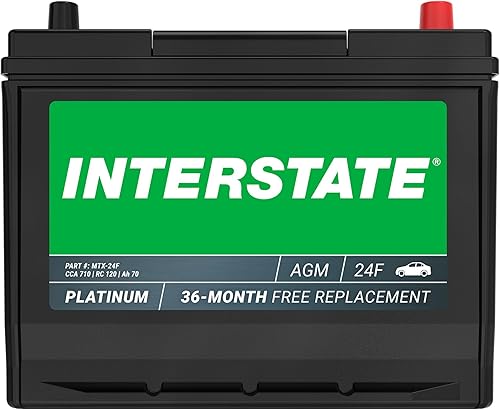
The Interstate MTX-24F AGM and M-24F flooded batteries give a same-brand example in Group 24F. They differ in construction and listed starting power, so use them to understand the tradeoffs, not as a fit recommendation for every car.
 Best for conventional replacement needs
Interstate M-24F Flooded (Group 24F)
AGM vs lead acid car battery: what is the difference?
AGM is a sealed form of lead acid battery, while flooded lead acid has free-flowing liquid inside its cells. Both are 12-volt lead acid batteries, but their construction affects maintenance, spill risk and vehicle compatibility.
In an AGM battery, fiberglass mats hold the electrolyte. The Interstate MTX-24F is described as maintenance-free and spill-proof, with valve-regulated technology.
A conventional flooded battery contains liquid electrolyte. The Interstate M-24F is a conventional flooded design, so it doesn't have the same spill-proof construction described for the AGM model.
This difference doesn't make one type right for every car. Begin with the battery type in your owner’s manual, then compare the exact battery size and electrical requirements.
Which battery type does your car need?
Use the battery type your vehicle maker specifies or approves. Don't switch from AGM to flooded, or the other way around, based only on a general claim about performance or lifespan.
Some vehicles require AGM, including some start-stop vehicles. Others may support more than one battery type, but that depends on the exact make, model, year and equipment.
Check your owner’s manual or vehicle fit information. Our guide on whether you can put an AGM battery in your car walks through the compatibility question.
If the manual is unclear, ask a qualified service professional to confirm the approved type. A battery that physically fits can still be the wrong match for the vehicle’s charging system.
How do AGM and flooded batteries compare?
AGM favors sealed construction and spill resistance; flooded lead acid offers a conventional design. Compare the features that matter to your car instead of treating the battery types as direct upgrades.
| Feature | AGM | Flooded lead acid |
|---|---|---|
| Electrolyte | Held in fiberglass mats | Free-flowing liquid |
| Spill resistance | Sealed, spill-proof design | Not described as spill-proof |
| Maintenance | Maintenance-free design | Follow vehicle and battery guidance |
| Example here | Interstate MTX-24F, 710 CCA | Interstate M-24F, 530 CCA |
| Vehicle fit | Must be confirmed | Must be confirmed |
The Interstate examples share Group 24F sizing, but their listed cold cranking amps differ. The MTX-24F is rated at 710 CCA, while the M-24F is rated at 530 CCA.
That comparison doesn't show that every AGM battery has more starting power than every flooded battery. Check the exact model against your vehicle’s minimum CCA and fit requirements.
Does AGM mean more starting power?
Compare the CCA rating of the exact battery with your car’s requirement. Battery type alone doesn't tell you whether a particular model provides enough starting power.
In this example, the AGM model has a higher CCA figure than the flooded model. A different pair of batteries may have different ratings, so check the number on the battery details and your vehicle guidance.
If you need help interpreting the CCA requirement, see how many cold cranking amps you need. Don't use a higher CCA number to overlook a wrong group size or incompatible battery type.
Is AGM worth choosing over flooded lead acid?
AGM is worth considering when your car requires AGM or its sealed construction solves a real need. If your car supports flooded lead acid and doesn't call for AGM, compare the exact models and their required features before paying more for a different design.
AGM construction can be useful where spill resistance matters. Interstate describes the MTX as spill-proof and vibration resistant, with electrolyte suspended in fiberglass mats.
Interstate also says the MTX has an expected service life 3 times longer than a conventional flooded battery. That's a manufacturer claim, not a promise that every MTX battery will last that long in every car.
Battery life also depends on vehicle condition, climate and driving pattern. Read how long AGM batteries last in a car for factors that can affect service life.
A flooded battery may suit a vehicle that allows it and a buyer who wants a conventional replacement. The Interstate M-24F provides 95 minutes of reserve capacity and 530 CCA, but check whether those figures meet your car’s requirements.
What should you check before replacing your battery?
Confirm type, group size, terminal layout and required CCA before you order. These details determine whether the battery fits and works with your vehicle.
Group size describes the battery’s physical dimensions and terminal arrangement. The 2 Interstate examples are both Group 24F with top posts, but that doesn't mean Group 24F fits every car.
Check the battery label or manual for the group size and terminal position. Our guide to car battery group sizes can help you understand the size code.
Also compare CCA and reserve capacity where the vehicle maker specifies them. See what battery reserve capacity means if you want to understand how that rating differs from starting power.
How do you choose between these 2 batteries?
Choose the MTX-24F if your vehicle calls for a Group 24F AGM battery and its 710 CCA meets the requirement. Choose the M-24F if your car allows flooded lead acid and its 530 CCA and fit match your vehicle.
The MTX-24F’s AGM construction holds electrolyte in fiberglass mats and is described as spill-proof and maintenance-free. It may suit a car that needs AGM or a driver who wants that sealed design.
The M-24F is a conventional flooded battery with 95 minutes of reserve capacity. It may suit a compatible vehicle when its CCA and group size meet the manufacturer’s requirements.
Neither model should be chosen by type name alone. Confirm fit for your year, make, model and equipment before buying.
Which battery should you choose for your car?
Pick AGM when your vehicle requires it or when its sealed design is a useful fit; pick flooded lead acid when your car approves it and the exact battery meets its specifications. Start with the manual, then verify size, terminals and CCA.
For these Group 24F examples, the MTX-24F provides 710 CCA and AGM construction, while the M-24F provides 530 CCA in a conventional flooded design. Choose only after confirming your vehicle’s fit and battery requirements.
If you’re replacing an old battery, use the car battery replacement guide to check the details before you buy.
External references
See the comparison
| Product | Best for | Type | Size | Starting power | Our score |
|---|---|---|---|---|---|
| Interstate MTX-24F AGM | AGM replacement needs | AGM | Group 24F | 710 CCA | 7.9 |
| Interstate M-24F Flooded (Group 24F) | conventional replacement needs | Flooded lead acid | Group 24F | 530 CCA | 6.6 |
Frequently asked questions
Is AGM better than flooded lead acid?
AGM is better when your vehicle requires it, or when its sealed, spill-proof construction fits your needs. Flooded lead acid can be a suitable conventional replacement when the vehicle allows it and the battery meets its size and starting requirements.
Neither type is the right choice for every car.
Can I replace an AGM battery with a flooded battery?
Only if your vehicle maker allows that battery type. Check the owner’s manual or ask a qualified service professional before switching, because some vehicles have charging systems or start-stop features designed for AGM.
Match the group size, terminal layout and required starting power too.
Does an AGM battery last longer than a flooded battery?
Service life depends on the battery design, vehicle, climate and use. Interstate says its MTX AGM is expected to last 3 times longer than a conventional flooded battery, but that is a maker claim, not a guaranteed result for every car or driving pattern.
What should I check before buying a car battery?
Confirm the battery type, group size, terminal position and required cold cranking amps in your owner’s manual or fit guide. A battery can share the right general type and still be the wrong fit.
Our car battery replacement guide explains what to check before you buy.
Do AGM batteries need a different charger?
Use a charger that supports the battery type and follow both the charger and battery instructions. AGM batteries use absorbed glass mat construction, so choose the correct charging mode if your charger offers one.
For a vehicle battery, follow the car maker’s guidance as well.