Can You Jump-Start an AGM Battery?
Yes, you can jump-start an AGM battery when it's simply flat. Connect the good battery to the AGM in the correct order and keep the donor vehicle running briefly, but a deeply drained AGM needs a proper AGM charger rather than repeated jumps.
On this page (7 sections)
- Can you jump-start an AGM battery safely?
- What do you need before jumping an AGM battery?
- How do you jump-start an AGM battery step by step?
- Why does an AGM battery go flat in the first place?
- What are the risks of jump-starting an AGM battery?
- Should you charge an AGM battery instead of jumping it?
- When should you stop jumping and replace the battery?
Yes, you can jump-start an AGM battery when it's simply flat. Connect the good battery to the AGM in the correct order, start the car, and remove the cables in reverse, then let the alternator do the rest.
A deeply drained AGM is a different story and wants a proper charger, not jump after jump. AGM batteries start cars the same way flooded batteries do, so the cables and voltage match.
What changes is how the battery recovers afterward and how careful you need to be about voltage and cable order. The steps below keep the jump safe and tell you when to stop jumping and start charging.
Can you jump-start an AGM battery safely?
Yes, a short, correct jump is safe for a 12V AGM battery. The AGM chemistry handles the brief burst of current a jump start supplies, as long as the donor battery matches the AGM's voltage.
The risk isn't the jump itself. It's the mistakes around it, like reversed cables or a 24V donor feeding a 12V AGM.
An AGM is sealed, so correct polarity matters more, not less. Check the AGM's label before you connect anything, and pair a 12V AGM with a 12V donor.
Many trucks and RVs run 24V, so confirm the voltage on both vehicles first. Treat the jump as a rescue, not a fix.
If the AGM starts the car and stays charged after a drive, the jump did its job. If it goes flat again within days, the battery or the charging system needs attention.
What do you need before jumping an AGM battery?
Gather jumper cables rated for the current, a charged donor battery, and eye protection before you open the hood. A load tester is useful afterward to confirm the AGM took the charge.
- Jumper cables with clean, undamaged clamps.
- A donor vehicle or jump pack at the same voltage as the AGM.
- Safety glasses, since batteries can spit acid if a clamp slips.
Inspect the AGM for cracks, swelling or leaking first. A sealed AGM that looks swollen or smells strongly shouldn't be jumped, so have it checked or replaced instead.
Clean crusted terminals with a wire brush so the connection is solid.
How do you jump-start an AGM battery step by step?
Connect positive first, negative last, then start the car. The order protects you and the electronics on both vehicles.
- Park the donor vehicle close but not touching the AGM car.
- Connect one red clamp to the AGM battery's positive terminal.
- Connect the other red clamp to the donor battery's positive terminal.
- Connect one black clamp to the donor battery's negative terminal.
- Connect the last black clamp to an unpainted metal ground on the AGM car, away from the battery.
- Start the donor and let it idle briefly, then start the AGM car.
- Remove the clamps in reverse order: ground, donor negative, donor positive, AGM positive.
The final black clamp goes to a ground point rather than the AGM's negative post to reduce spark risk near the battery. Look for a bracket or engine block bolt away from fuel lines and painted metal.
Once the AGM car runs, drive it for 20 to 30 minutes rather than idling in the driveway. If the car won't start after a couple of tries, stop and charge the AGM properly.
Why does an AGM battery go flat in the first place?
Most flat AGM batteries come from a drain, a weak charging system or age. Finding the cause keeps you from jumping the same battery every week.
Short trips are a common culprit. A car that only does a few miles at a time never gives the alternator enough run time to replace what the start took out.
Accessories left on or a stuck glovebox light can drain a parked car. An AGM sitting in a vehicle that isn't driven for weeks will drop on its own.
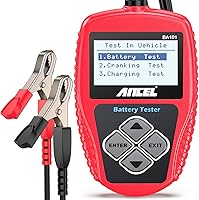
An AGM past its service life will keep letting you down. Cranking performance and internal resistance are the two readings that show this best, which is where a battery tester earns its place in the toolbox.
Which tester suits a first battery check?
The Foxwell BT705 is the pick for one-person testing across 12V and 24V systems, because its 5.9 ft cable reaches from the battery to the driver's seat. It checks CCA, voltage, internal resistance and state of health, and it covers flooded, AGM, GEL and EFB batteries from 100 to 2000 CCA.
The 2.8-inch screen summarizes results as GOOD, RECHARGE or REPLACE, which helps when you don't want to interpret every number. It ships with a hard case for garage storage.
Which tester fits a quick garage check?
The VDIAGTOOL BT500 is the choice for a compact all-in-one check on cars, trucks, motorcycles and boats. It handles 6V, 12V and 24V batteries and reports voltage, resistance, state of health and state of charge.
It also runs cranking and charging tests, so you can tell a weak battery from a tired alternator. It's built for flooded, AGM flat plate, AGM spiral, GEL and EFB batteries.
It doesn't cover lithium or deep-cycle batteries.
When is a new AGM the better answer?
An AGM that won't hold a charge after a proper recharge is ready to replace. The Optima RedTop 34/78 is a sealed 12V AGM with 800 cold cranking amps for cars, trucks and SUVs that need strong starts in cold weather.
Optima says its SpiralCell design resists vibration and lasts up to 3 times longer than a standard flooded battery. It's maintenance free and non-spillable, so it can mount in more positions.
Its 50 AH C20 capacity suits basic electrical demands rather than heavy accessory loads.
What are the risks of jump-starting an AGM battery?
The main risks are reversed polarity, wrong voltage and sparking near the battery. Each one is easy to avoid with a careful setup.
Reversed cables can blow fuses, damage electronics or hurt the battery. If you see a spark when connecting the final clamp, stop and check every connection.
A 24V donor on a 12V AGM can cook the battery or the electronics, so confirm system voltage first. Don't jump a frozen AGM, since a battery that froze while discharged can crack internally and a jump can then cause a short.
Avoid repeated jump attempts in one sitting; two tries is enough, then switch to a charger.
Should you charge an AGM battery instead of jumping it?
Charge instead when the AGM is deeply discharged, has sat flat for a while, or keeps dying after a jump. Charging restores the battery properly; jumping only gets you moving.
An AGM that sat at low charge for weeks needs a slow recharge on an AGM setting. Jumping won't reverse the sulfation that builds up during long storage.
If you want to know whether a regular charger is safe to use, read our guide on whether you can I charge AGM battery with regular charger.
After charging, check the reserve capacity of the battery. That number tells you how long it can run accessories if the alternator fails, and a low figure on a freshly charged AGM points to wear.
Our explainer on what is a battery reserve capacity walks through how to read it.
A tester reading after the charge is the final check. If the AGM still reads REPLACE, plan for a new battery.
Replacing an AGM with a different chemistry changes the charging needs, so read up on whether you can I put an AGM battery in my car before you swap types.
When should you stop jumping and replace the battery?
Stop jumping once the AGM won't hold a charge after a proper recharge. Repeated jumps are a sign the battery is past its useful life, not a fix for it.
An AGM near the end of its life may start the car cold but fail in the next cold snap. A load test that shows low CCA or high internal resistance tells you it's time.
Plan the replacement before the next long trip or hard freeze. Old batteries shouldn't go in the trash; most auto parts stores accept them, and our guide on how to recycle a car battery covers drop-off options.
Jump-starting an AGM battery is a safe rescue when the car is simply flat. Match the voltage, connect positive to positive and negative to ground, start the car and remove the cables in reverse.
If the AGM won't stay charged after a drive or a proper recharge, test it and replace it rather than jumping it again.
Frequently asked questions
Can you jump start an AGM battery with a regular car?
Yes. A car with a charged 12V battery can supply the jump, and you connect positive to positive and negative to a ground point on the AGM car.
Keep the donor running only long enough to start the car, then drive it so the alternator can recharge.
Is jump-starting an AGM battery different from a flooded one?
The cable order and voltage match a flooded battery, so the basic procedure is the same. The difference is what happens after: an AGM that sat deeply discharged needs a charger with an AGM setting to come back to full health.
How long should I leave the jumper cables connected?
Connect the cables, start the AGM vehicle within a few seconds, then remove the cables in reverse order. There's no need to leave the donor idling for many minutes; the goal is to get the engine started so the alternator takes over.
Why does my AGM battery keep going flat?
Frequent flat AGM batteries usually point to a drain, a weak alternator or an aging battery. A load tester reading of cranking and charging performance separates a battery that needs charging from one that needs replacing.