Will a Car Alternator Charge an AGM Battery?
Yes, a healthy car alternator will charge an AGM battery, as long as it holds a charging voltage in the AGM-friendly range of about 13.8 to 14.8 volts. A low or unstable output leaves the battery short of full charge, so test the charging system before trusting it with AGM.
On this page (7 sections)
- Will a car alternator charge an AGM battery at all?
- What charging voltage does an AGM battery need?
- How do you check whether your alternator charges AGM properly?
- Why might an alternator fail to keep an AGM battery full?
- Does an AGM battery need a different charger from the alternator?
- When should you replace the battery instead of the alternator?
- What should you do before trusting your alternator with an AGM battery?
Yes, a car alternator will charge an AGM battery when the charging system is healthy and its output sits in the AGM-friendly range. Most alternators regulate between about 13.8 and 14.8 volts, which is exactly where an AGM battery wants to be charged.
The real question is whether your particular alternator actually delivers that. A worn regulator, corroded cables or a long run of thin wire can drag the voltage down and leave the battery undercharged.
That matters more with AGM than with a basic flooded battery, so it's worth a quick check.
Will a car alternator charge an AGM battery at all?
Yes, in normal use a car alternator is a fine charger for an AGM battery. AGM is still a lead-acid battery, and it accepts the same regulated voltage an alternator supplies to a flooded battery.
What changes is the tolerance. AGM batteries are sealed and recombinant, so they can't be topped up with water.
If the alternator overcharges them, the excess gas has nowhere to go and the battery dries out internally. If it undercharges them, sulfate builds on the plates and capacity drops.
That's why the voltage window matters so much. An alternator that holds a steady 14.2 to 14.6 volts with the engine running keeps an AGM battery happy.
One that swings up past 15 volts or sags below 13.5 volts is a problem.
The charge also depends on time. An alternator charges while the engine runs, so a battery only gets topped up as much as you drive.
A car that does ten-minute trips every day will never fully recharge an AGM battery, no matter how good the alternator is.
What charging voltage does an AGM battery need?
An AGM battery wants roughly 14.4 to 14.8 volts during the main charging phase and about 13.2 to 13.8 volts to hold it at full charge. These are the usual figures for 12-volt AGM starting batteries.
Your alternator's regulator is built to land somewhere in that window. The trouble is that the regulator only sees the voltage at its own sense point, not necessarily at the battery posts.
Voltage drops along old cables, corroded terminals and body grounds pull the reading down.
So the number that matters is what you measure at the battery itself. If the alternator is set for 14.4 volts but 0.5 volts is lost in the wiring, the battery only sees 13.9 volts.
That's enough to keep it alive but not enough to fully charge it over time.
AGM batteries also charge a little differently in the absorption stage. A smart charger holds that stage at a controlled voltage until current tapers off.
An alternator can't do that, because its output varies with engine speed. It gets the battery most of the way there, which is fine for a starting battery.
How do you check whether your alternator charges AGM properly?
Measure the voltage at the battery terminals with the engine running and the lights and accessories off. A healthy charging system should read in that 13.8 to 14.8 volt band.
Start with the engine off and everything switched off. A fully charged AGM battery rests around 12.6 to 12.8 volts.
Then start the engine, let it idle, and take the reading again. A jump of more than a volt tells you the alternator is doing something.
Next, switch on the headlights and the blower and watch the reading. A small dip is normal.
A large drop or a voltage that keeps climbing past 15 volts is a warning sign. Our guide on how to test a car battery with a multimeter walks through the readings and what each one means.
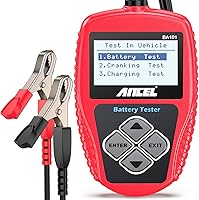
A dedicated tester makes this easier because it reads the charging system as well as the battery. The ANCEL BA101 tests charging and cranking alongside state of health and state of charge.
The BA101 supports 12-volt batteries from 30Ah and up, including flooded, AGM, GEL and EFB types. Enter the battery type and CCA rating from the label so the results line up with the real battery.
It isn't built for lithium batteries or for 6-volt and 24-volt systems.
If you want to test across more than one vehicle, the VDIAGTOOL BT500 covers 6-volt, 12-volt and 24-volt batteries in one unit.
Its charging test is the useful part here. Run the engine and the BT500 reports whether the alternator is recharging the battery or whether a no-start is coming from a weak battery instead.
It supports flooded, AGM flat plate, AGM spiral, GEL and EFB batteries.
Why might an alternator fail to keep an AGM battery full?
The usual cause is not the alternator itself but the voltage it can deliver to the battery. Resistance in the charging path eats the difference before the current arrives.
Common culprits include:
- Corroded or loose terminals, which add resistance right at the battery.
- A worn or dirty ground strap, which skews the regulator's reading.
- An old voltage regulator that holds a lower setpoint than AGM likes.
- Short trips, which never give the alternator enough run time.
- A failing diode or worn brushes in the alternator, which reduce output.
A smart charging system in newer cars adds another wrinkle. Some vehicles deliberately charge the battery only partway to save fuel, then top it up on deceleration.
That strategy works with the battery the car was built for. Swapping in a different AGM type can leave the system confused unless the battery is registered.
Our post on whether you can put an AGM battery in my car covers the fit and registration questions.
If the alternator tests fine but the battery still reads low, look at the cables and grounds before replacing parts. A clean, tight connection often recovers most of the missing voltage.
Does an AGM battery need a different charger from the alternator?
No. The alternator is the charger while you drive, and it's enough for normal starting use.
A separate charger only comes into play when the car sits or the battery is deeply discharged.
That's when AGM's charging profile matters. A regular old-fashioned charger can overcharge a sealed battery if it has no voltage limit.
A smart charger switches stages and holds a safe absorption voltage, so the battery finishes full without gassing off its electrolyte. For the details on charger types, read whether you can charge an AGM battery with a regular charger.
The alternator can't do that staged finish. It charges hard while the engine runs and stops when you park.
For a car in daily use, that's fine. For a weekend car or one that sits for weeks, a smart charger on a maintenance schedule keeps the AGM battery at full charge.
When should you replace the battery instead of the alternator?
Replace the battery when the charging system tests healthy but the battery won't hold a charge. Replace the alternator when the charging voltage stays low or unstable.
The split is easy to check. Charge the AGM battery fully with a smart charger, let it rest, and measure it.
If it settles at 12.6 volts or better and still won't start the car the next morning, the battery is the problem. If the charging voltage with the engine running sits below 13.5 volts, the alternator or its wiring is the problem.
Age matters too. A 12-volt AGM starting battery wears down over years of use, and a hard life of short trips shortens that.
If yours is old and already weak, a new AGM with a healthy alternator will charge properly from day one. A spiral-wound AGM like the Optima RedTop is one option when you want strong cranking and vibration resistance.
Optima rates the RedTop 34/78 at 800 cold cranking amps with dual SAE and GM posts. It's maintenance free and can be mounted in many positions because it's non-spillable.
The spiral design is built for vibration resistance, which suits trucks and off-road use.
What should you do before trusting your alternator with an AGM battery?
Test the charging voltage first, fix any wiring faults, and then let the alternator do its job. If the system holds the right range, an AGM battery will charge normally in everyday driving.
So, will a car alternator charge an AGM battery? Yes, provided the voltage lands in the AGM band and the car gets enough run time.
Check the output at the posts, clean the terminals and grounds, and use a smart charger for any battery that sits unused. When the battery finally fails, take it to a proper drop-off rather than the trash, and see how to recycle a car battery for the steps.
Frequently asked questions
Can a standard car alternator charge an AGM battery?
Usually yes. Most modern alternators hold a regulated output between about 13.8 and 14.8 volts, which sits inside the range AGM batteries accept.
Older vehicles with weak regulators or long cable runs may fall short, so check the actual voltage at the battery posts with the engine running.
Does AGM need a special charger or a special alternator?
No special alternator is required in most vehicles. AGM batteries accept the same regulated charging voltage as flooded batteries.
A dedicated smart charger helps more when the battery sits unused or needs a full top-up, because it can hold a controlled absorption stage.
How do I know my alternator is charging my AGM battery properly?
Measure voltage at the battery terminals with the engine idling and electrical loads off. A reading around 13.8 to 14.8 volts means the alternator is charging.
A reading near 12.6 volts or lower with the engine running points to a charging problem.
Will short trips keep an AGM battery charged?
Often not. Short trips give the alternator little time to replace the energy used at each start, and repeated undercharging is the usual reason AGM batteries fail early.
A longer drive or a smart charger on a regular schedule keeps the battery closer to full charge.
Can a faulty alternator damage an AGM battery?
Yes. A failing regulator can push voltage too high, which overheats the battery and shortens its life.
A weak alternator leaves it undercharged instead.
Either way, fixing the charging system first protects the battery, so test before you swap in a new AGM.
Do I need to change anything when switching to an AGM battery?
In most cars, no. The battery physically fits the same tray and the alternator charges it the same way.
Some vehicles with smart charging systems need the battery type registered so the charging strategy adjusts, so check your owner's manual for that step.