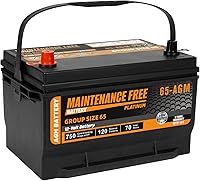
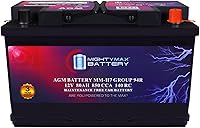
How Do You Identify an AGM Battery?
You identify an AGM battery by reading its case label for the letters AGM or the words absorbed glass mat, valve regulated or VRLA. A spiral-wound case and a sealed, maintenance-free design are strong extra clues that the battery is AGM rather than flooded.
On this page (9 sections)
- What words on the label confirm an AGM battery?
- How does the case shape give away an AGM battery?
- Does a sealed, maintenance-free design mean AGM?
- Can the group size tell you the battery type?
- How can a battery tester help you check the battery?
- What does an AGM battery look like next to a flooded one?
- Why should you confirm the type before charging or replacing?
- How do you identify an AGM battery when the label is worn?
- What's the fastest way to identify an AGM battery?
You identify an AGM battery by reading its case label for the letters AGM or the words absorbed glass mat, valve regulated or VRLA. A spiral-wound case and a sealed, maintenance-free design are strong extra clues that the battery is AGM rather than flooded.
Knowing the type matters before you charge, replace or recycle a battery. A wrong charger setting or the wrong replacement type can shorten the battery's life.
This guide walks through the checks in the order that gives the clearest answer.
What words on the label confirm an AGM battery?
The words AGM, absorbed glass mat, valve regulated or VRLA on the case label confirm it. Those terms describe the same sealed design, so any one of them is a reliable signal.
Start with the large printed text on the top or front of the case. Many batteries print the type in bold next to the group size.
A label that reads "AGM" or "Absorbed Glass Mat" leaves no doubt.
VRLA stands for valve regulated lead acid. It is an umbrella term that includes AGM and gel batteries, so a VRLA label without more detail needs a second look for AGM or spiral cell wording.
Gel batteries are sealed too but use a different electrolyte, so the distinction matters for charging.
If the label is worn or missing, look for a part number on the case and check the manufacturer's catalog. The type usually appears in the model code, as it does with the ACDelco Gold 94RAGM.
That model number carries both the group size and the AGM wording in one short string, so it doubles as your proof of type when the sticker has faded.
How does the case shape give away an AGM battery?
A spiral-wound, six-sided case is a clear sign of an AGM battery. Spiral cell designs roll the plates and separator into tight cylinders, so the top shows round cell outlines instead of flat rectangular caps.
The Optima RedTop 34/78 uses this spiral cell layout. Its AGM construction wraps pure lead plates with an absorbed glass mat separator, and the case is sealed and non-spillable.
A standard flooded battery instead has flat plates under six removable caps.
Most AGM batteries still use a conventional rectangular case. A flat black case with top posts can be either type, so case shape only helps when the battery is spiral-wound.
Treat shape as a supporting clue and let the label decide. The RedTop's spiral design is the exception rather than the rule, so don't expect every AGM you meet to look like it.
Does a sealed, maintenance-free design mean AGM?
A sealed, maintenance-free battery is usually AGM, but not always. Some flooded batteries are sold as low-maintenance with sealed tops, so "maintenance free" alone isn't proof.
The stronger test is the caps. An AGM battery has no removable cell caps, because its electrolyte is held in glass mat separators and it never needs water.
A battery with six twist-off caps you can open is flooded.
A valve regulated design also vents gas through a pressure valve instead of open caps. If the case shows a small valve or a sealed top with no water ports, AGM becomes the likely answer.
The ACDelco Gold 94RAGM describes exactly this setup, a leak-resistant pressurized valve system that replaces the open vents of a flooded case.
Can the group size tell you the battery type?
No, a group size alone never confirms AGM. Group sizes like 34, 35, 94R or H7 describe the case dimensions and terminal layout, not the internal chemistry.
The same group size can be sold as flooded or AGM. A 94R case might hold a flooded battery in one car and an AGM battery in another.
The size code tells you what fits the tray; the type label tells you what's inside.
Use the group size to narrow your replacement search. Then read the type wording to match the battery your vehicle's charging system was built for.
If you're considering a switch, our guide on whether you can put an AGM battery in my car covers the charging and compatibility questions.
How can a battery tester help you check the battery?
A conductance tester confirms the battery's health once you've identified its type, but it doesn't identify the type for you. You select AGM or flooded from the menu, so the label check still comes first.
The Topdon BT200 tests batteries from 100 to 2000 CCA across flooded, AGM, GEL and deep-cycle types. Its 3-in-1 diagnosis covers battery health, cranking and the charging system.
A color screen shows a simple Good or Replace prompt.
A tester is most useful after you know the type. Set the correct profile, then read the result.
Testing an AGM battery on a flooded setting gives a misleading picture of its health. The BT200's memory function also recalls your last test, so you can compare a reading taken before a cold snap with one taken after and see whether the battery has slipped.
What does an AGM battery look like next to a flooded one?
Side by side, an AGM battery often looks like a cleaner, sealed version of a flooded battery. It usually has a smooth, closed top with no water ports and no visible cell caps.
A flooded battery shows six caps or a removable vent cover across the top. Its case may have a liquid level line or a built-in hydrometer eye.
Neither feature appears on a sealed AGM.
The ACDelco Gold 94RAGM is a good example of a conventional-looking AGM. It uses a standard Group 94R/H7 case with a leak-resistant pressurized valve system.
Nothing on the outside shouts AGM, so the printed label and part number carry the answer.
Why should you confirm the type before charging or replacing?
Charging an AGM battery on a flooded profile can overcharge it, and a mismatched replacement can undercharge. AGM batteries accept charge at a different rate and voltage, so the charger and the vehicle both need to match.
Most modern smart chargers have an AGM setting. Choose it, and check the charger's manual for the correct rate.
Avoid fast charging or equalizing modes meant for flooded batteries. AGM batteries also recharge faster than flooded ones, which is one reason the wrong profile can push too much current too quickly.
For a replacement, match the type your vehicle was built for. Swapping a flooded battery for an AGM is sometimes fine and sometimes not, depending on the charging system.
Reserve capacity also differs by design; our explainer on what a battery reserve capacity is shows how to read that number on the label.
When a battery reaches the end of its life, don't put it in the trash. Our guide to how to recycle a car battery covers drop-off options and safety steps.
A jump start on an AGM battery also follows its own rules, so read whether you can jump start an AGM battery before reaching for cables.
How do you identify an AGM battery when the label is worn?
When the label is worn, use the part number and the case details together. A model code or a stamped number on the case usually points to the exact battery, and the manufacturer's catalog confirms the type.
Look on the top, the front face and near the terminals for a stamped or printed code. Photograph it before cleaning the case so you don't lose the numbers.
Then match the code to the model.
Product picks that show the two AGM looks
If no code survives, the sealed top and absence of cell caps point toward AGM. Treat that as a strong hint, not proof, and confirm with a dealer or parts store before buying a charger or replacement.
The Optima RedTop 34/78 is an 800 CCA AGM starting battery with dual SAE and GM posts. Its spiral cell construction makes the AGM design visible at a glance.
That makes it a handy reference point when you're learning what an AGM case looks like. Its dual SAE and GM terminals also mean the same battery can drop into more than one post layout, so check which terminals your vehicle uses before you order.
The ACDelco Gold 94RAGM fits select Audi, Buick, Cadillac, Mercedes-Benz, Chevrolet, Jeep and GMC vehicles. It's a 12V AGM in a standard Group 94R/H7 case.
Its plain look is a reminder to read the label first. Confirm year, trim and engine against the fit tool before buying, since the 94R/H7 size only fits certain models in those lines.
What's the fastest way to identify an AGM battery?
The fastest reliable check is the label. Read the case for AGM, absorbed glass mat, valve regulated or VRLA wording, and confirm the battery has no removable cell caps.
Use spiral cell shape and part number lookup as backup clues when the label is unclear.
Once you know the type, set your charger and tester to match. If you plan to replace it with a different type, check compatibility first.
For a like-for-like swap, match the group size and the AGM wording, and recycle the old battery at an approved drop-off.
Frequently asked questions
Can an AGM battery look the same as a flooded one?
Yes. Many AGM batteries use a standard black case and top terminals that look almost identical to a flooded battery.
The label is the reliable clue, so read the printed type wording rather than judging by shape or color alone.
What does VRLA mean on a battery label?
VRLA stands for valve regulated lead acid, and it is an umbrella term that covers AGM and gel batteries. If a label says VRLA without naming AGM, look for absorbed glass mat or spiral cell wording to confirm which sealed type you have.
Does an AGM battery have removable cell caps?
No. AGM batteries are sealed and maintenance free, so they have no removable caps for adding water.
A battery with six twist-off caps you can open is a flooded battery, not an AGM one.
Can a battery tester tell me whether my battery is AGM?
Most testers ask you to select the battery type before testing, so they don't detect it for you. A conductance tester like the Topdon BT200 lets you choose AGM from its menu, but you still need to confirm the type from the label first.
Why does it matter whether my battery is AGM?
AGM and flooded batteries have different charging needs. A charger set to the wrong profile can undercharge or overcharge an AGM battery, and a replacement must match the type your vehicle's charging system expects.