How to Maintain an AGM Battery
To maintain an AGM battery, keep it fully charged, clean and tighten the terminals, and test it every few months so a weak cell shows up before it strands you. AGM batteries are sealed, so the work is mostly about charging habits and load checks, not adding water.
On this page (9 sections)
- What makes AGM battery care different from a flooded battery?
- How should you charge an AGM battery?
- How do you keep the terminals and case clean?
- How do you test an AGM battery's health at home?
- How often should you check and top up an AGM battery?
- What shortens an AGM battery's life?
- Which tester should you keep in the garage?
- What should you do with an AGM battery that won't hold a charge?
- The simple AGM maintenance routine
To maintain an AGM battery, keep it fully charged, clean and tighten the terminals, and test it every few months so a weak cell shows up before it strands you. AGM batteries are sealed, so the work is mostly about charging habits and load checks, not adding water.
That changes the routine compared with an old flooded battery. You can't open the case or top up the electrolyte, so how you charge and store the battery does most of the work of keeping it alive.
What makes AGM battery care different from a flooded battery?
An AGM battery is sealed and holds its acid in glass mats, so there's no water level to check and no caps to remove. Care focuses on charge voltage, terminal condition, and load testing instead.
The mats keep the electrolyte in place, which is why AGM batteries tolerate vibration and mounting angles that would spill a flooded battery. The trade-off is that overcharging cooks the mats, and once the acid is lost there's no way to replace it.
That makes charging precision the single biggest maintenance lever. A charger that pushes too much voltage for too long does damage you can't undo.
If you're not sure which type you have, our guide to how do you identify an AGM battery walks through the labels and case markings. Knowing the type matters before you connect any charger.
How should you charge an AGM battery?
Charge AGM batteries with a smart charger or one set to its AGM mode, and let it finish the full cycle rather than stopping when the gauge looks good. The charger should taper current as the battery fills and hold a float voltage afterward.
A flooded-battery charger set to its normal profile can push an AGM cell too hard. The sealed case can't vent the excess the way an open battery can, so the glass mats dry out and capacity drops.
Charge in a ventilated space and keep the charger off wet ground. Don't leave a basic charger connected overnight on a battery you don't trust; use one with automatic shutoff or float mode.
For a battery in a stored vehicle, a maintainer that holds a steady float charge is the simplest option. Monthly top-ups beat one long session every few months, because shallow cycles are gentler on a sealed battery.
Charging habits that shorten AGM life
The habits that hurt most are letting the battery sit flat and charging at the wrong voltage. A battery left below about half charge for weeks sulfates faster, and a mismatched charger adds heat on top.
Short trips are another quiet cause. A car that only does five-minute runs never replaces the charge the starter used, so the battery drifts down over months.
How do you keep the terminals and case clean?
Disconnect the negative terminal first, then clean and dry both posts and clamps before reconnecting. Dirt and corrosion add resistance, and that resistance makes the battery work harder at every start.
Use a terminal brush or a mix of baking soda and water on the posts, then rinse and dry completely. A light coat of terminal protector or petroleum jelly slows the white and blue crust that comes back.
Check the case for cracks or bulging while you're there. A swollen AGM case means the battery has been overcharged or overheated, and it should come out of service.
Make sure the hold-down clamp is snug. A battery that shifts under braking can crack its case or loosen a terminal, and the clamp is easy to overlook during a wash or oil change.
How do you test an AGM battery's health at home?
Test voltage at rest and then under load, because a resting voltage alone won't show a battery that's about to fail. A battery that reads fine sitting still can sag hard the moment the starter turns.
Check resting voltage with everything off and the surface charge gone. Then load-test to see how the voltage holds while current flows.
That's the step that separates a healthy AGM from one that's merely charged.
The Foxwell BT705 tests 12V and 24V systems across 100 to 2000 CCA and covers flooded, AGM, GEL and EFB batteries. Its 5.9 ft cable reaches from the battery to the driver's seat, so you can watch cranking voltage alone, and results come back as GOOD, RECHARGE or REPLACE.
When should you load-test an AGM battery?
Run a load test before a long trip, after a deep discharge, and whenever starting sounds slower. Those are the moments when a marginal battery is most likely to leave you stuck.
Write down the readings so you can compare them next time. A slow downward trend across months tells you more than any single test, and it gives you time to shop for a replacement on your terms.
How often should you check and top up an AGM battery?
Check the battery about once a month and top up its charge whenever voltage sits low. A stored or lightly used AGM battery benefits from a monthly smart-charger session more than from occasional long drives.
Season matters too. Heat speeds up self-discharge and corrosion, so summer is the time to look more often.
Cold slows the chemistry, which is when a weak battery shows its limits at the first frost.
If the vehicle sits for weeks, a maintainer keeps the charge steady without overfilling a sealed cell. For a battery kept on a shelf, charge it fully before storage and again every month or so.
What shortens an AGM battery's life?
Deep discharges, overcharging, heat and vibration are the four main killers of a sealed AGM battery. Most of them come from habits you can change.
Letting accessories run with the engine off drains the battery further than a starter ever does. Parking over hot pavement or next to a hot engine bay adds heat that dries the glass mats.
Loose terminals and a loose hold-down add vibration and resistance. A quick check at each oil change catches both before they cost you a battery.
If you're adding a battery to a second vehicle or swapping types, read can I put an AGM battery in my car first. The charging system has to suit the battery, or good maintenance won't save it.
Which tester should you keep in the garage?
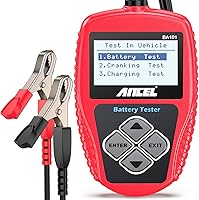
A tester that reads state of health and CCA is the most useful tool for AGM upkeep, because it catches a fading battery before a no-start. A simple voltmeter tells you the charge, not the condition.
The Schumacher BT-100 runs three tests in one device and covers motorcycle, ATV, lawn tractor, car, boat, light truck and RV batteries. It uses a 50-amp load test on 6V and a 100-amp test on 12V, with a top-mounted rocker switch and an analog meter you can read while you hold it.
The QWORK 24338 handles 6V and 12V batteries up to 1,000 CCA and adds an alternator test. It comes in a shock-resistant steel case with copper-plated clamps, and its compact size and handle make it easy to store.
Choose the Foxwell BT705 if you want state-of-health and internal-resistance readings for AGM, EFB and GEL batteries. Pick the Schumacher BT-100 for a simple analog load test across many vehicle types.
Go with the QWORK if a steel case and an alternator check matter most for the price tier.
What should you do with an AGM battery that won't hold a charge?
Try a slow recharge on an AGM-mode smart charger first, then test it under load, and replace it if the reading stays low. A battery that won't hold voltage after a full charge has usually lost capacity for good.
Don't keep charging a battery that gets hot or smells sulfurous. That's a sign of internal damage, and continuing to charge it is a safety risk.
When you replace it, check the reserve capacity rating against your needs; our guide to what is battery reserve capacity explains what the number means in practice. And never put the old battery in the trash.
Our walkthrough on how to recycle a car battery covers where it can go.
The simple AGM maintenance routine
Anyone learning how to maintain an AGM battery can follow the same short loop: charge it correctly, keep the terminals clean, and test it under load every few months. Those three habits prevent most failures and give you warning before one.
Charge with an AGM-mode smart charger and avoid letting the battery sit flat. Clean and tighten the terminals at each oil change.
Test state of health and CCA so you can plan a replacement instead of reacting to one.
Pick the Foxwell BT705 if you want detailed health readings, the Schumacher BT-100 for a straightforward analog load test, or the QWORK 24338 for a steel-cased unit with an alternator check. Whichever you keep, a few minutes a month is what keeps a sealed battery in service.
Frequently asked questions
Can you add water to an AGM battery?
No. AGM batteries are sealed, and the electrolyte is held in glass mats rather than sitting as free liquid.
Opening the case or adding water damages the seal and voids the battery, so keep the top closed and rely on correct charging instead.
How often should an AGM battery be charged if it sits unused?
Top it up with a smart charger about once a month when the vehicle or battery is stored. Long idle periods let the voltage drift down, and repeated deep discharges are what age a sealed battery fastest.
Does an AGM battery need a special charger?
Yes, use a charger with an AGM setting or a smart charger that limits voltage. A standard flooded-battery charger can overcharge a sealed AGM cell, and the repair is usually a new battery rather than a top-up.
Can an AGM battery be brought back after a deep discharge?
Sometimes a slow recharge on a smart charger will recover it, but a battery left flat for weeks often loses capacity for good. Test it under load before trusting it, and replace it if the reading stays low.