Will a Battery Tender Plus Charge an AGM Battery?
Yes, a Battery Tender Plus can charge an AGM battery as long as it is a 12V battery and you select the AGM or lead-acid setting on the charger. Match the charger's amperage to the battery's size, and the maintenance mode will hold it at full charge.
On this page (8 sections)
- What does the Battery Tender Plus actually do?
- Is an AGM battery safe on a lead-acid charger?
- Which setting should you use for an AGM battery?
- How long does it take to charge an AGM battery?
- When is an AGM battery too far gone to charge?
- Can you leave the Battery Tender Plus connected all winter?
- What should you check before connecting an AGM battery?
- Bottom line on will a Battery Tender Plus charge an AGM battery
Yes, a Battery Tender Plus will charge an AGM battery when the battery is 12V and you set the charger to its AGM or lead-acid mode. The charger's smart stages match the voltage an absorbed glass mat battery wants, so it can top up and then hold it without boiling off electrolyte.
The trick is knowing which setting to pick and when the battery is simply too far gone for any maintainer to save. This guide covers both.
What does the Battery Tender Plus actually do?
The Battery Tender Plus is a smart charger that runs a staged charge and then holds the battery at full. It starts with a bulk stage, moves to absorption, and finishes in a float or maintenance mode, which is why people leave it connected for months.
That staged behavior is what makes it safe for AGM. A plain trickle charger keeps pushing a fixed current, which can overcharge a sealed battery over time.
The Battery Tender Plus watches voltage and backs off once the battery is full.
The unit is a maintainer first, so its output is modest. It suits keeping a healthy battery topped up, not quick-charging a dead one before a morning commute.
Plan for a slow refill rather than a fast one.
One detail that matters on a sealed battery is heat. The absorption stage is where a charger can do harm if it holds voltage too long, and a sealed case has no caps to pop or water to top up.
The float stage is gentler still, adding only what the battery loses while sitting.
Is an AGM battery safe on a lead-acid charger?
Yes, AGM is a lead-acid chemistry, so a charger meant for 12V lead-acid batteries can charge it provided it reaches the right voltage and doesn't overheat the battery. AGM batteries are sealed and use a glass mat to hold the electrolyte, so they tolerate less gassing than a flooded battery.
The two common mistakes are using a high-amp fast charger and using an old unregulated trickle unit. Both can push voltage too high, and a sealed AGM has no way to replace lost water.
A staged charger like the Battery Tender Plus avoids that by capping the absorption stage.
Check the battery label for its chemistry and voltage before anything else. Then set the charger to match; if the unit has only one mode and the label says AGM, confirm the maker lists it as compatible.
Which setting should you use for an AGM battery?
Use the AGM setting if your Battery Tender Plus has one; otherwise use the standard lead-acid mode. AGM batteries want a slightly different absorption voltage than flooded ones, and the charger's AGM profile is tuned for that.
Some versions of the charger have a selectable switch, and some detect battery type automatically. Read the case markings and pick the mode that names AGM, sealed, or absorbed glass mat.
If the only options are lead-acid and lithium, pick lead-acid and never lithium for an AGM.
Setting the wrong chemistry mostly costs you charge quality, not safety, on a well-regulated charger. But a lithium profile on an AGM can leave it undercharged, and an AGM profile on a flooded battery can push it a little hard.
| Battery type | Charger setting | Why |
|---|---|---|
| Flooded lead-acid | Lead-acid or standard | Matches higher gassing tolerance |
| AGM | AGM or sealed | Holds absorption voltage lower |
| Gel | Gel if listed | Needs the gentlest voltage |
| Lithium | Never on this charger | Different charge algorithm |
EFB batteries, common on stop-start cars, sit close to AGM in how they want to be charged, so the AGM or sealed setting is the safer pick there too.
How long does it take to charge an AGM battery?
A flat AGM battery takes several hours to a full day, depending on its amp-hour rating and how deeply it was drained. A small powersport battery refills fastest; a large car or marine battery takes longer on a maintainer.
A useful rule is that charge time scales with the battery's capacity divided by the charger's output. That's why a 1.25-amp maintainer is a keeper, not a rescue tool.
If the battery is deeply discharged, expect most of a day before the full-charge light holds steady.
Battery reserve capacity tells you how long a battery can deliver current before it drops, which is a rough sign of how much energy you're asking the charger to replace. Our explainer on what is a battery reserve capacity covers the number in more detail.
Cold slows the chemistry down, so a battery that accepts charge quickly in summer may sit in bulk longer on a winter bench. A warm, dry spot for the charger helps the stages finish on time.
When is an AGM battery too far gone to charge?
A 12V AGM battery that rests below about 10.5V is often beyond saving, and a maintainer may refuse to start on it. The charger's fault light is the tell: it senses a voltage too low to charge safely.
Sulfation is the usual cause. When an AGM battery sits discharged, lead sulfate hardens on the plates and stops accepting charge.
A smart charger can sometimes break down light sulfation with a recovery stage, but a long-dead battery usually stays dead.
Before you give up, test the battery properly. A digital tester gives you state of health and cranking amps, not just voltage, so you can see whether the plates are still working.
The Topdon BT200 runs cranking and charging tests as well as battery health, which helps you separate a weak battery from a weak alternator. Its clamps are copper, and it works across 12V and 24V systems from 100 to 2000 CCA.
TOPDON also builds in a memory function that recalls your last test, which is handy when you are tracking a battery over a winter of sitting. It tolerates temperatures from -4°F to 140°F, so a freezing garage morning does not stop the reading.
Should you test before or after charging?
Test after the charger finishes and the battery has rested, because a battery fresh off the charger reads artificially high. Give it an hour or two, then measure.
If you don't own a tester, a multimeter gets you a resting voltage reading. Our walkthrough on how to test a car battery with a multimeter shows where to place the probes and what the numbers mean.
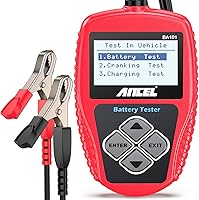
The ANCEL BA101 accepts the common rating standards and reads in plain language, so a home user can see whether a battery is worth keeping on the maintainer. It supports batteries over 30Ah and is not for lithium or non-12V packs.
Feed it the battery type, the rating from the label and the temperature, and the state of health reading reflects what the battery can actually hold rather than just its surface voltage.
Can you leave the Battery Tender Plus connected all winter?
Yes, the maintenance stage is designed for long-term connection, so a stored vehicle or seasonal battery can stay hooked up through winter. The charger drops to a float voltage and only adds current when the battery falls.
Keep the charger dry, off the floor, and in a spot with some airflow. Make sure the clamps grip clean terminals, and check the settings one last time before storing.
If you check the voltage partway through the season with a multimeter, expect a healthy resting figure in the low 12s on the volt scale. A number that keeps drifting down between checks points to a battery that no longer holds what the charger gives it.
If the vehicle stays parked, the battery still self-discharges, so the maintainer earns its keep. If the alternator is part of the picture, our guide on will a car alternator charge an AGM battery explains how driving and charging voltage interact.
What should you check before connecting an AGM battery?
Check voltage, chemistry and the charger's amp rating before the clamps go on. The battery should be 12V and the charger should be rated for its size; a maintainer is fine for most car batteries, not for an industrial bank.
Look at the terminal condition too. Crust and loose clamps add resistance and can fool a charger into thinking the battery is fuller than it is, so clean and tighten first.
Then confirm the charger sits somewhere it will not be knocked or rained on.
What about a battery that won't hold a charge?
If the battery charges to full and then falls flat within days, it has likely lost capacity. A load test shows whether it can still deliver cranking amps under demand.
The Schumacher BT-100 covers 6V and 12V batteries up to 1,000 cranking amps, with a 50-amp load test on 6V and 100-amp on 12V. It also checks the charging system and starter draw.
It is the older style of test, so you watch the gauge drop rather than read a state of health number.
For amperage details, use the CCA rating on the battery label and set the tester to match. When a battery has failed, take it to a recycler rather than the trash; our guide on how to recycle a car battery covers where it can go.
Bottom line on will a Battery Tender Plus charge an AGM battery
For most owners, the answer to will a Battery Tender Plus charge an AGM battery is a straightforward yes: set the AGM or lead-acid mode and let the maintainer do its staged charge. Pick it for topping up a healthy 12V AGM over winter or between drives.
Test the battery first if it has been sitting dead, and skip the charger entirely if it reads below about 10.5V and won't recover. A tester tells you which situation you're in, and a recycler handles the battery that has reached the end.
Frequently asked questions
Can a Battery Tender Plus overcharge an AGM battery?
No, because it switches to a float or maintenance stage once the battery reaches full charge. That low-current hold keeps the battery topped up without pushing it past its voltage limit, which is why it can stay connected for long storage periods.
Does an AGM battery need a different charger from a flooded one?
It needs a charger that reaches the right voltage and knows the AGM profile. Many modern smart chargers, including the Battery Tender Plus, offer a selectable AGM or lead-acid mode, so you set the type and the charger manages the rest.
Why does my Battery Tender Plus show a fault light on an AGM battery?
A fault light usually means reversed clamps, a battery below the charger's minimum voltage, or a shorted cell. Recheck polarity and the connections first, then test the battery's resting voltage before trying again.