How Many Cold Cranking Amps Do I Need?
Most cars need the minimum cold cranking amps (CCA) listed in the owner’s manual or on the original battery. Match or exceed that rating, and confirm the battery group size, type, and terminal layout before buying.
On this page (7 sections)
- How many cold cranking amps does my car need?
- Does a higher CCA battery work in a car?
- Where can you find your vehicle’s CCA requirement?
- Which battery details matter besides CCA?
- Which batteries show different CCA ratings?
- How should you choose between CCA ratings?
- How many cold cranking amps should you choose?
Most cars need the minimum cold cranking amps (CCA) listed in the owner’s manual or on the original battery. Match or exceed that rating, then confirm the battery group size, type, dimensions, and terminal layout.
If you’re asking how many cold cranking amps your car needs, start with its exact year, make, model, engine, and equipment. The right CCA can vary by vehicle configuration, and cold weather can make extra starting capacity useful.
How many cold cranking amps does my car need?
Use the vehicle maker’s minimum CCA as your baseline. Check the owner’s manual, the label on your current battery, or a vehicle-specific fit guide.
If those sources disagree, ask a qualified parts professional to confirm the requirement for your exact vehicle. Don’t guess from engine size alone; two versions of the same model can have different battery requirements.
A battery that meets the CCA number can still be the wrong choice. Check group size, chemistry, dimensions, terminal positions, and any start-stop requirements before buying.
Our guide to what size battery your car needs explains how group size affects fit.
Does a higher CCA battery work in a car?
A higher CCA rating may work if the battery also meets your vehicle’s fit and type requirements. It doesn’t make an incompatible battery suitable.
Compare the rating against the maker’s minimum, but treat fit as a separate check. A battery with the wrong case size or terminal arrangement can be difficult or unsafe to install.
If your car originally uses AGM, check the manual before switching to another battery type. Some vehicles require a specific chemistry or charging setup.
How does cold weather affect CCA?
Cold weather reduces a battery’s ability to supply starting power, while the engine may need more effort to turn over. A battery that meets the vehicle’s minimum can be a sensible starting point, with more CCA worth considering when the maker allows it.
Don’t use a larger CCA number to cover a weak battery, poor connections, or a charging problem. If the car struggles to start, our guide to signs of a bad car battery can help you sort out what to check next.
Where can you find your vehicle’s CCA requirement?
Check the owner’s manual first, then compare it with the original battery label. The manual is useful when the battery has already been replaced or the label is hard to read.
Record the battery type and group size alongside the CCA figure. If you’re replacing the battery, also check its case dimensions and terminal positions before ordering.
Vehicle-specific guides can help narrow down the fit. For example, see what battery a Honda CR-V needs or what battery a Chevy Silverado 1500 needs, then confirm the details for your own year and engine.
Which battery details matter besides CCA?
CCA is only one part of choosing a replacement. Match the group size, battery chemistry, dimensions, terminal layout, and any vehicle-specific requirements.
Group size describes the battery’s physical fit and terminal arrangement. Use our guide to car battery sizes when you need help understanding those group numbers.
Battery type matters too. If you’re unsure whether AGM is required or suitable, read can I put an AGM battery in my car?.
Which batteries show different CCA ratings?
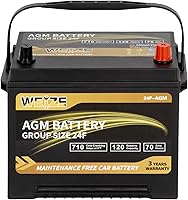
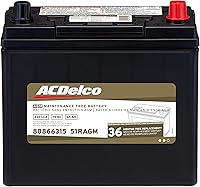
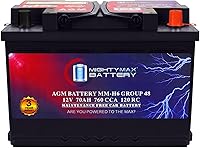
These examples have different group sizes and CCA figures, so they illustrate why you should match the vehicle requirement rather than pick by CCA alone. Confirm that any option fits your exact car before buying.
The ACDelco Gold 94RAGM is a Group 94R/H7 AGM battery for select vehicle applications. Check your vehicle’s fit and minimum CCA first.
The Weize Platinum AGM Group 35 is rated at 650 CCA. Its maker advises checking battery dimensions, terminal position, CCA, and type against the vehicle’s requirements.
The Weize Platinum AGM Group 48 is described with a 760 CCA rating. Verify the Group 48 fit and vehicle requirements before considering it as a replacement.
The Goodyear Platinum AGM Group 94R is rated at 850 CCA. Its Group 94R size and terminal layout still need to match your vehicle.
How should you choose between CCA ratings?
Choose a battery that meets the vehicle maker’s minimum and fits the car. Consider a higher CCA rating only after confirming the correct chemistry, group size, dimensions, and terminals.
For a replacement, write down the original battery’s CCA and group size before shopping. If the old label is missing, use your owner’s manual or a vehicle-specific fit guide.
If the car still has starting trouble after a correct replacement, check the connections and charging system instead of moving to a higher CCA number. Follow the vehicle manual for service steps, and use a qualified mechanic if you’re unsure.
To install a replacement yourself, see how to change a car battery safely. For a final fit check, review car battery replacement basics.
How many cold cranking amps should you choose?
For most drivers, the right CCA is the maker’s minimum or higher, as long as the battery otherwise fits and meets the vehicle’s requirements. Use the manual or original battery label as your guide, and factor in cold weather only within those limits.
Pick the battery by vehicle fit first, then compare CCA. Continue with what size battery your car needs if you need to confirm group size.
Frequently asked questions
How many cold cranking amps does my car need?
Your car needs at least the minimum CCA stated in its owner’s manual or on the original battery label. Match or exceed that number, then confirm the battery chemistry, group size, dimensions, and terminal positions.
If the manual gives different requirements by engine or climate, use the one for your exact vehicle and conditions.
Is it okay to use a battery with higher CCA?
A battery with higher CCA can be suitable if it also matches your vehicle’s required battery type, group size, dimensions, and terminal layout. CCA alone does not confirm fit.
Follow the owner’s manual, especially for vehicles with start-stop systems or other battery requirements.
Do I need more CCA in a cold climate?
Cold weather makes starting harder, so a higher CCA rating can offer more starting capacity in low temperatures. Still, meet the vehicle maker’s minimum first and stay within its fit and battery-type requirements.
Don’t choose a battery by climate alone if its size or chemistry is wrong.
What does CCA mean on a car battery?
Cold cranking amps measure a battery’s ability to deliver starting current in cold conditions under a standard test. A higher number means more rated starting current in that test, but it doesn’t tell you whether the battery fits your vehicle or meets its other electrical needs.