Car Battery Replacement: What to Know Before You Buy
For car battery replacement, match the battery to your vehicle’s year, make, model and engine, then confirm its group size, terminal layout, type and required starting power. Check the owner’s manual or fitment guide before buying, and have the old battery tested if the cause of the problem is unclear.
On this page (9 sections)
- What should you check before car battery replacement?
- Is the battery actually the problem?
- How do you choose a battery type?
- How much starting power do you need?
- Which replacement battery examples can you compare?
- What should you compare after confirming fit?
- Do you need a professional to install it?
- How should you dispose of the old battery?
- How should you narrow down your car battery replacement?
Car battery replacement starts with the right fit for your vehicle, not just a battery that can start an engine. Check your car’s required group size, terminal layout, battery type and starting power before comparing brands or features.
If the battery is slow to crank, has trouble holding a charge or is past its expected service life, confirm the diagnosis before buying. A charging problem or a loose, corroded connection can cause symptoms that resemble a failing battery.
This guide covers what to check, how to compare replacement options and what to plan for during installation. For a vehicle-specific starting point, use our guide to what size battery your car needs.
What should you check before car battery replacement?
Before buying, confirm the battery specification your vehicle calls for. Use the owner’s manual, a trusted fitment guide or a parts professional who can check your exact year, make, model and engine.
Check these details together:
| What to check | Why it matters |
|---|---|
| Group size | Sets the battery’s main dimensions and terminal locations |
| Battery type | Your vehicle may call for flooded lead-acid, AGM or another type |
| Terminal layout | Cables must reach the correct posts without strain |
| Starting power | The replacement must meet your vehicle’s starting requirement |
| Hold-down and clearance | The battery must fit securely without touching nearby parts |
The same model name can cover different engine options, and those options may use different batteries. Confirm fitment by year and engine instead of relying only on the model name.
For a closer look at dimensions and terminal placement, see our guide to car battery group sizes. If you know the vehicle, our Chevy Silverado 1500 battery guide and Honda CR-V battery guide show how fitment can vary by vehicle.
Is the battery actually the problem?
A battery that will not start the car may be discharged, worn out or affected by another electrical fault. A basic battery and charging-system test can help narrow down which one.
Common clues include slow cranking, dim lights, a battery warning, or needing repeated jump starts. These signs do not prove the battery is the cause.
Loose terminals, a weak alternator, an electrical drain or leaving accessories on can also reduce starting power.
If the battery looks swollen, cracked or is leaking, don’t try to test or charge it yourself. Keep away from the fluid and arrange safe handling through a repair shop or battery recycler.
A multimeter can check voltage, but a resting voltage reading alone may not show how well a battery performs under load. Our guide to testing a car battery with a multimeter explains what that measurement can and cannot tell you.
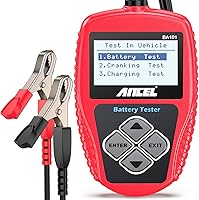
For a tool that checks battery, cranking and charging-system status, consider the {{product B08CMPY86M | The TOPDON BT200 checks 12V and 24V batteries, cranking and charging systems.}}
How do you choose a battery type?
Choose the battery type your vehicle specifies, then compare other compatible options. AGM and flooded lead-acid batteries differ in construction and may not be interchangeable for every vehicle.
AGM batteries hold electrolyte in a glass mat rather than free-flowing within each cell. They are used in some start-stop applications, but your vehicle’s charging system and requirements determine whether AGM is appropriate.
Flooded batteries are common in many vehicles, but the right choice still depends on fit and manufacturer guidance. Don’t assume that a battery with the right group size is also the right type.
For the differences in construction and use, read our AGM vs lead-acid battery comparison. If your car currently has AGM, our guide answers whether you can put an AGM battery in your car.
The {{product B008FWCLHU | The ACDelco Gold 48AGM is a Group 48/H6 AGM option for vehicles that call for that size and type.}} Its listed fitment covers select makes and models, so check your exact vehicle before choosing it.
How much starting power do you need?
The replacement must meet your vehicle’s required cold cranking amps (CCA), especially if you drive in cold weather. Check the manual or battery label for the minimum rating rather than guessing by engine size.
CCA measures a battery’s ability to deliver starting current in cold conditions. A higher CCA number does not make an incompatible battery fit, and it does not replace checking group size, terminals or chemistry.
Use our cold cranking amps guide to understand how to compare the rating. Keep the vehicle’s stated requirement as your baseline.
Which replacement battery examples can you compare?
Start with batteries that match your required group size and type. These examples cover three distinct sizes, so they are comparison points rather than universal recommendations.
The Mighty Max MM-H7 is a Group 94R AGM battery with 80 Ah capacity, 850 CCA and a 140-minute reserve capacity. {{product B0CZM9G3J1 | The Mighty Max MM-H7 gives Group 94R shoppers a stated 850 CCA and 140-minute reserve capacity.}}
The Goodyear Platinum AGM Group 35 is a 12V battery with 55 Ah capacity, 650 CCA and a 100-minute reserve capacity. {{product B0FH7JGQNY | The Goodyear Platinum AGM Group 35 gives Group 35 shoppers a stated 650 CCA and 100-minute reserve capacity.}}
Neither battery is a fit just because its ratings look suitable. Confirm the required group size, type and terminal placement for your specific vehicle before ordering.
What should you compare after confirming fit?
Once fitment is settled, compare warranty, battery design and useful ratings among options that meet your vehicle’s requirements. A strong warranty or higher rating cannot make the wrong size safe to install.
- Warranty: Check the replacement period and terms, including whether coverage depends on registration or proof of purchase.
- Battery type: Match the vehicle’s requirement for AGM, flooded lead-acid or another design.
- Starting power: Make sure the CCA rating meets the vehicle’s requirement.
- Reserve capacity: Compare this if you need to understand how long a battery may support electrical loads if the charging system stops.
- Date code: A battery’s age can matter while it waits in storage. Learn how to read a car battery date code.
- Local support: Consider whether you can get help with fitment, warranty service and recycling in your area.
Keep the comparison focused on features that matter for your vehicle and driving conditions. Avoid paying extra for ratings you don’t need while overlooking fit or battery type.
Do you need a professional to install it?
You can replace many car batteries at home if you follow the vehicle’s service instructions and use the right safety steps. Some vehicles need a memory saver, battery registration or special procedures, so check the manual before disconnecting anything.
A car battery can deliver enough current to cause burns, damage tools or start a fire if its terminals are shorted. Wear eye protection, remove metal jewelry and keep tools away from both posts at once.
If the battery is difficult to reach, sits near sensitive electronics or has a complicated hold-down, use a qualified technician. Stop if you see corrosion that has spread, damaged cables or signs of a leak.
Follow your vehicle’s sequence for disconnecting and reconnecting terminals. If you’re handling the replacement yourself, use our step-by-step guide to changing a car battery safely.
How should you dispose of the old battery?
Take the old battery to a collection point that accepts automotive batteries. Lead-acid batteries contain materials that should be recovered through a proper recycling program, not placed in household rubbish.
Many auto parts shops and battery retailers accept old batteries, but check with the location before making a trip. Your local waste authority may also list hazardous waste or battery collection sites.
Keep the battery upright during transport and protect its terminals from metal objects. If it is damaged or leaking, ask the recycler or repair shop how they want it handled before moving it.
Our guide to recycling a car battery covers what to expect at a collection point.
How should you narrow down your car battery replacement?
Choose the battery that matches the vehicle’s required group size, type, terminal layout and starting power. If the diagnosis is uncertain, test the battery and charging system before buying.
Pick a compatible AGM battery when your vehicle calls for AGM, and compare warranty and ratings only among options that fit. Then arrange safe installation and take the old battery to a collection point.
For fitment details, start with what size battery your car needs.
Frequently asked questions
How do I know which car battery to buy?
Check your owner’s manual or a reliable vehicle fitment guide for the required group size, battery type and minimum starting power. Match the battery’s dimensions, terminal position and hold-down style to your car, then compare warranty and features among compatible options.
Can I replace my car battery with a different group size?
Use a different group size only if your vehicle maker or a qualified parts professional confirms it fits and meets the electrical requirements. A battery that seems close in size can have terminals in the wrong place or fail to secure properly.
Should I replace a battery that keeps going flat?
Test the battery and charging system before replacing a battery that repeatedly goes flat. A weak alternator, electrical drain, loose connection or short-trip pattern can cause similar symptoms, so a test can help identify the next step.
Can I replace an AGM battery with a regular battery?
Follow the vehicle maker’s battery type requirement. Some vehicles are designed for AGM, including certain start-stop systems, and switching to a flooded battery may affect charging or service life.
Check the manual or ask a qualified technician before changing battery chemistry.
What should I do with the old car battery?
Take an old lead-acid car battery to an auto parts retailer, battery recycler or local hazardous waste program that accepts them. Don’t put it in household trash.
Keep it upright and avoid contact with leaking fluid or damaged terminals.