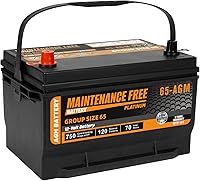
Do AGM Batteries Last Longer?
Yes, an AGM battery usually lasts longer than a flooded battery of the same quality. Two to three times longer is the common claim for AGM in normal use, and the gap widens when the battery sees vibration or deep cycling.
On this page (8 sections)
- Why does an AGM battery last longer than a flooded one?
- Which AGM uses get the longest service life?
- What shortens an AGM battery's life?
- How do you check an AGM battery's real condition?
- Does the battery type in your car decide if AGM lasts longer?
- How do group size and fit affect AGM service life?
- Should you pay more for AGM when life matters?
- How do you get the full life out of an AGM battery?
Yes, an AGM battery usually lasts longer than a flooded battery of the same quality. Two to three times longer is the common claim for AGM in normal use, and the gap widens when the battery sees vibration or deep cycling.
That longer life is not automatic. An AGM only earns its advantage when charging, heat and depth of discharge stay within its design.
An AGM abused the same way as a cheap flooded battery will often die sooner.
Why does an AGM battery last longer than a flooded one?
The glass mat holds the electrolyte in place, so the battery resists vibration and spill far better than a flooded design. Optima credits its spiral-wound plates with 15 times the vibration resistance of a standard flooded battery.
Flooded batteries lose active material from their plates as they shake and cycle. The mat in an AGM keeps the paste pressed against the plate, which slows that shedding.
Fewer loose particles mean less internal shorting over the years.
The sealed design also cuts water loss. A flooded battery needs topping up, and a neglected one runs dry and sulfates.
An AGM keeps its acid locked in the mat, so the chemistry stays stable for longer. Autocessking notes its AGM suspends the acid within glass fiber mats to prevent leaks, spills and corrosion, which keeps the electrolyte where it belongs.
Optima says its YellowTop lasts up to 3 times as long as a standard flooded battery. Autocessking gives its AGM a 2 to 3 times service-life claim.
Those are maker claims, but both point the same way.
Which AGM uses get the longest service life?
AGM wins biggest in high-vibration and deep-cycle duty. Trucks, winch rigs, audio builds and start-stop cars all put stress on a battery that a flooded design handles poorly.
Vibration is the clearest case. An AGM's mat holds the plates steady, so a truck that spends hours on rough ground sees less plate damage.
A flooded battery in the same truck often fails early from shaken-loose active material.
Deep cycling is the second case. A dual-purpose AGM like the Optima YellowTop is built to recover from repeated discharges.
Optima describes it as one of the only true dual-purpose automotive batteries, with cranking power plus cycling capability. A flooded starting battery pushed into the same cycling role loses capacity fast.
Start-stop vehicles also suit AGM. The engine restarts hundreds of times a day, and the battery must accept charge quickly between stops.
An AGM's low internal resistance makes that easier. That fast recharge is part of what keeps an AGM in a start-stop car ahead of a flooded replacement.
What shortens an AGM battery's life?
Charging faults are the main killer. An AGM left partly charged for weeks sulfates, and a charger that pushes too much voltage overheats it.
Both cut life more than ordinary driving does.
An AGM needs a controlled charge profile. If you top it up with an old charger that has no AGM setting, the voltage can climb past what the battery wants.
The battery accepts current fast, so the finish stage matters.
Heat is the next big factor. AGM batteries hold less electrolyte than flooded ones, so sustained heat dries them out faster.
A battery mounted next to exhaust or turbo plumbing runs hotter than one in a cooler spot. Autocessking builds its AGM with heat and cold resistance, but no AGM outlasts a mounting spot that cooks it every day.
Short trips do quiet damage. The alternator never gets long enough to refill the battery, so it lives at partial charge.
Our guide on whether an AGM battery is sensitive to overcharging covers the voltage side in more detail.
How do you check an AGM battery's real condition?
Test it under load and read the state of health, not just the resting voltage. A tired AGM can show 12.6 volts at rest and still fail on a cold morning.
Resting voltage only tells you the charge level. A load test and a cranking check show whether the plates can still deliver current.
That is where the ANCEL BA101 fits.
It reads state of health, state of charge, voltage, current and CCA, and runs cranking and charging tests. It supports AGM, flooded, GEL and EFB types on 12V batteries over 30Ah.
Testing at the battery's rated CCA gives the clearest picture. A reading well below the label rating means the AGM has lost capacity and its longer-life window is closing.
The tester's protection against reverse polarity and short circuits also makes it safer to clamp on in a tight engine bay where a slip is easy.
How often should you test an AGM?
Test it once a year, and again before winter. An AGM rarely gives warning before it fails, so a scheduled check catches the decline while you can still plan a replacement.
Enter the battery type and CCA rating from the label so the reading matches the battery's own numbers.
Does the battery type in your car decide if AGM lasts longer?
Match the replacement to what the car was built for. A car that came with AGM needs AGM, because its charging system expects that profile.
Swapping in flooded saves money now and costs you later.
Autocessking spells out the rule in its fit notes: an AGM car should not switch to flooded. Charging voltage in those cars runs higher to top up AGM quickly, and a flooded battery boils off water under that schedule.
Going the other way is more forgiving. A flooded car can often move up to AGM, and the sealed design brings longer life and better vibration resistance.
Check that the group size and CCA match before buying. Measure the old battery and note the year, make, model and engine if you need help confirming the fit.
The battery's own rating matters too. A start-stop AGM with a 3-year warranty is built for frequent cycling.
A basic AGM in the same size is not, and it will not last as long in that role.
How do group size and fit affect AGM service life?
The right group size protects the battery, because a loose hold-down lets it shake and a wrong terminal layout strains the cables. Fit is part of life, not just a buying detail.
Autocessking's Group 48 AGM is a 12V, 70Ah unit rated at 760 CCA with 120 minutes of reserve capacity. It is a start-stop battery, not a deep-cycle one.
Group 48 fits many European and modern domestic cars.
Its maker puts service life at 2 to 3 times a flooded battery. The low self-discharge also helps a car that sits for days or weeks, since the battery holds charge longer between drives.
Check the hold-down and cable reach before installing any AGM. A battery that moves in its tray loses life to vibration no matter how good its plates are.
Should you pay more for AGM when life matters?
Buy AGM when you plan to keep the car or the battery sees hard duty. The longer service window and vibration resistance pay back over the years.
For a short-trip city car with a flooded system, a good flooded battery is the cheaper call.
Truck owners with winches or high electrical loads get the most from AGM. Our roundup of the best AGM truck battery covers the dual-purpose options built for that load.
The Optima YellowTop D34/78 is the clear pick for heavy accessory use. It is a 12V, 750 CCA dual-purpose battery with a 55Ah capacity and 120 minutes of reserve capacity.
Its dual SAE and GM terminals and 10 by 6 7/8 by 7 13/16 inch case suit a wide range of trays.
Its spiral-wound plates and dual terminals suit owners who run winches, big audio or commercial gear. The maker's 3 times life claim lines up with the vibration-resistant build.
The maintenance-free sealed design also means no topping up between services.
If your car came with AGM and the old battery is aging out, replace it with AGM. That is where the longer-life question actually pays off.
How do you get the full life out of an AGM battery?
Keep it charged, keep it cool and keep it tight in the tray. Those three habits decide whether an AGM reaches its longer-life window or fails early like any abused battery.
Drive long enough to recharge it, or use an AGM-rated maintainer on a car that sits. Check the charging voltage once a year and clean the terminals so resistance stays low.
Keep the mount away from exhaust heat where the design allows. A battery that holds its charge in storage, like the low self-discharge AGM above, still wants a top-up before a long idle spell.
When the battery does fail, recycle it rather than binning it. Our guide on how to recycle a car battery covers the drop-off options.
For expected timelines, see how long do AGM batteries last in a car.
So does an AGM battery last longer? Yes, in the right setup.
Pick AGM for hard duty or an AGM-equipped car, keep it properly charged, and it will outlast the flooded battery it replaced. Buy a flooded battery only when the car, the budget and the driving pattern all point that way.
Frequently asked questions
Why do AGM batteries fail early if they should last longer?
Most early AGM failures trace to chronic undercharging, overcharging or sustained heat, not to the glass mat wearing out. An AGM kept at partial charge for months will sulfate and lose capacity well before its design life.
Can a regular flooded battery charger ruin an AGM battery?
An older charger without an AGM setting can overcharge it. AGM batteries accept charge quickly and need a controlled finish, so use a charger with an AGM mode and confirm the charging voltage stays within the battery's published range.
Is AGM worth it for a car that only does short trips?
Only if the car came with AGM or you add regular longer drives. Short trips leave an AGM partly charged, which shortens its life and erases the advantage it holds over a cheaper flooded battery.
Does an AGM battery last longer when it is kept cool?
Yes. Heat speeds up the internal corrosion and water loss that end a battery's life, and AGM has less electrolyte to spare than a flooded battery.
A cool mounting spot away from exhaust and turbo heat helps any AGM reach its longer service window.